Showing posts with label e-portfolio. Show all posts

Monday, April 9, 2012

E-Portfolio Assignment

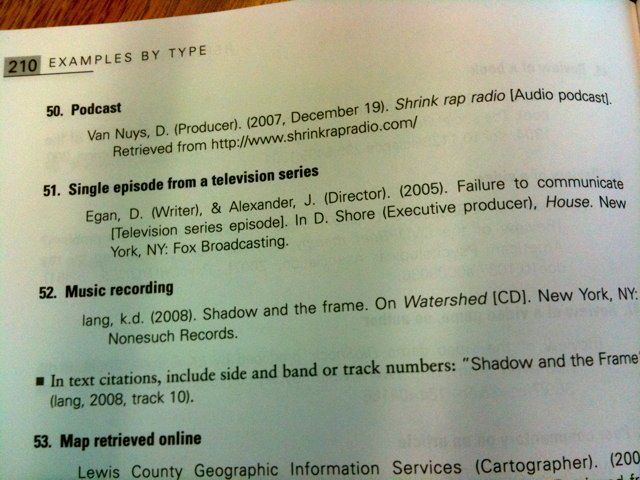
Shrink Rap Radio (2012). APA Style Manual [Image], Retrieved, April 9 2012,  from: URL http://www.shrinkrapradio.com/about/shrink-rap-radio-in-the-apa-style-manual/


I've had some more questions about the E-Portfolio which is due on the last day of class (the 13th of April).


  • NO you do not need to include a Delicious tag cloud. Delicious no longer supports this and your assignment does not ask you to do this. Please make sure you are looking at the current assignment (and not last term's one): found here.
  • Your final reflective blog post means I am looking for you to tell me about your learning throughout the term. You can disagree with using Facebook, LinkedIn, blogs, Twitter etc...BUT tell me why. Use examples to support your analyses. I am looking for you to show me your critical thinking; why you are thinking the way you do. Use examples, use resources, refer to class content and readings
  • In your final reflective blog post PLEASE remember to include the links to your FIVE comments that you have made throughout the term
  • YES even if you are including photos that you took (so there is no copyright issue) you MUST still include a caption/reference noting all the pertinent information following APA style

Again, if you have any questions, don't hesitate to e-mail me.

I'm including the assignment information below too:


ALES 204 E-Portfolio Term Project
Total Value: 35%

As we proceed through the term your writer’s toolbox will grow.  Blogging for this class will help you not only keep track of what you’ve been learning but it will also give you a space to stretch your communication muscles. Communicating well in various modes, text, image and sound are part of this class’s learning outcomes that you can practise in your own blog posts.
This term assignment is not really about specific instances of “science.”  Rather, this assignment is an opportunity to make broad observations of kinds of scientific knowledge and professional composition in relation to what we’re learning in the class.  You do not have to write a blog post for every single class that we have.  You must do at least five posts and two side-bar widgets.  In most instances I WILL assign you a blog post topic (such as the Introductory blog post and the final reflective post) – that will count as your E-Portfolio – but you will have the opportunity to choose ONE topic AND, if you wish to write any extra posts, those topics will be also be your choice (though they must be related to class content).  With this E-Portfolio you have a chance to participate in an online environment that is becoming increasingly important for the future; both in education and employment.  

At the end of the term, you will have written at least five blog posts.  In each blog post you must:
  1. Include at least one image
  2. Include at least one external link (somewhere out in the WWW)
  3. Include at least one reference to a fellow student’s blog post (you must link to the post, i.e. internal link)
  4. Be on topic (i.e. related to our class work).
  5. Each blog post should be at least two paragraphs but no more than four.

Additionally, throughout the term you must comment on at least five blog posts written by fellow students in this class. You can find links to the students’ blogs on the class blog, under the Module 2 blog post.

Comments, like all the writing and interaction in this class, must remain appropriate in level (writing style, mechanics and punctuation) and collegiality.  In your final blog post for this project you will need to include links to the five (or more) comments you made.

Mandatory Blog Post Topics
  • Module 2: Introductory Blog Post
  • Module 3: Embed the Flickr photo of your paper (or online) Facebook profile.
  • Module 10: Wikipedia stub entry (not required for CSL students)
  • Module 10: Optional Post (only for CSL students)

Additional E-Portfolio entries include (to be completed by the end of the term, 13th April.):
  • Embed your Twitter feed in the sidebar of your blog.
  • At least ONE blog post on a topic of your choice
  • Reflective blog post. Please add links to your FIVE comments here on your final reflective blog post.

Important Elements to Note:
1) All related links, images, audio and any other multimodal device must be appropriate, and you must CITE the reference information using APA style, even if the images are your own work.
2) The internet and computers can have hiccups. Save, save, save your work.  
3) Use your writer’s toolbox in your blogs – there’s no excuse for forgetting to capitalise, incorrect punctuation and txt spk (unless that is part of the assignment).
4) Remember to label your posts appropriately.
5) This is an individual project.  You are to write each blog post on your own. There is opportunity to collaborate by commenting on other blog posts.

Note on Computer Access:
You will have the chance to write blog posts on your own time and by using any of the computers available at the University of Alberta campus.  As a class we now have all lab sessions in computer labs during which there may be opportunity to craft a blog post.


Due Date: 13th April 2012, 17:00


Friday, March 23, 2012

Lecture 26: Wiki Work

During today's lecture you'll have MC and Erin in class, ready to answer any questions you might have about the intricacies of creating a Wikipedia article.


As a reminder:


Write a Good Article
Our goal is to produce a Good Article that will be of service to the general Wikipedia community. We need to have a sense of what more needs to be done, and an overall plan for the article. I suggest looking at examples and guidelines (e.g. Manual of Style or the Guide for nominating good articles), as well as reminding yourself of the criteria for a Good Article. I suggest finding an example of a Good Article related to your stub, and follow its structure including its section headings.
Remember:
This Wikipedia article forms part of the e-portfolio which means when you write your blog post ABOUT the writing of your article:
  1. Include at least one image
  2. Include at least one external link (somewhere out in the WWW – probably to your article)
  3. Include at least one reference to a fellow student’s blog post (you must link to the post, i.e. internal link)
  4. Be on topic (i.e. related to our class work).
  5. Each blog post should be at least two paragraphs but no more than four.
Suggestions and hints
  • You will be writing an encyclopedic article that is neutral and verifiable by established facts. You will not be collecting data, analyzing it, or writing about your experiences. You will not be writing an essay with personal opinions or judgments.
  • One of the exciting aspects of Wikipedia is its dynamic and communal nature. You are free (and encouraged) to use Wikiepdia's Peer Review to provide feedback on your article before submitting the final copy. It is likely that you will receive messages from editors. Be polite in replying, and don't hesitate to ask them to explain something.
  • Avoid simply copying text from a reference. Isolated quotations are okay, but most of time, it is better to use a summary or paraphrase of the quotation that flows better with the rest of your article. See Wikipedia policies on copying and quoting sources.
  • Here is a useful Wikipedia page giving general advice for writing good articles.
  • Have a read of this Wikipedia Cheatsheet that tells you all the wiki code you need to insert images or bold text etc.: http://webtrends.about.com/gi/o.htm?zi=1/XJ&zTi=1&sdn=webtrends&cdn=compute&tm=15&f=20&su=p284.12.336.ip_p504.1.336.ip_&tt=7&bt=1&bts=1&zu=http%3A//en.wikipedia.org/wiki/Wikipedia%3ACheatsheet
Note: When you register with Wikipedia, it is a good idea to use EITHER your twitter alias or your real name (if you choose) so that the professor and the TAs can track your contributions.

Note on Quality of E-Portfolio and Wikipedia Article Content:
Rating
Characteristics
4
Exceptional. The blog entry is focused and coherently integrates examples with explanations or analysis. The entry demonstrates awareness of its own limitations or implications, and it considers multiple perspectives when appropriate. The entry reflects in-depth engagement with the topic and demonstrates interaction and engagement with lecture content. Appropriate references are included to support arguments.
Submitted on time.

Wiki:
  • Length: For the purposes of this assignment, a reasonable article will contain 300-600 words, which correspond to 1.5-3 pages of standard double-space text.
Content: Neutral and verifiable
Uses quotations
Uses twitter alias or real name for revision history/marking purposes
3
Satisfactory. The blog entry is reasonably focused, and explanations or analysis are mostly based on examples or other evidence. Fewer connections are made between ideas, and though new insights are offered, they are not fully developed. The entry reflects moderate engagement with the topic and lecture content. Some references are included.

Wiki:
  • Length: follows the recommended standard
Content: Neutral and verifiable
Uses quotations or paraphrases where appropriate
Uses twitter alias or real name for revision history/marking purposes
2
Underdeveloped. The blog entry is mostly description or summary, without consideration of alternative perspectives, and few connections are made between ideas. The entry reflects passing engagement with the topic and lectures. Few references are included.

Wiki article most copies with a few paraphrases
little to no referencing/citations
length is insufficient
Not a recognisable name/twitter alias
1
Limited. The blog entry is unfocused, or simply rehashes previous comments, and displays no evidence of student engagement with the topic or lectures. Insufficient references to support content.

Wiki simply copies text from elsewhere, no references, incorrect length
0
No Credit. The blog entry is missing or consists of one or two disconnected sentences. No referencing.
Submitted after the deadline.


Wiki - does not follow any of the recommendations for content or length

Thursday, March 22, 2012

Wikipedia E-Portfolio Assignment

I have had a few questions from students so let me clarify this assignment a bit more.


The assignment to write on Wikipedia is really to show you how easy it is for anyone to create information there and hence, how unreliable it might be. Remember, in academia we're interested in peer-reviewed scholarly sources (usually!). It also helps you as students to become producers and communicators rather than simply consumers of information. This is something too that you can add to your CV to show how you engage with content (in your field).

BUT the way we will mark the assignment is really focused on the e-portfolio entry. If you look at the wikipedia assignment google doc you will see that the rubric is really geared to the analysis/critical interpretation of your ACT of writing the wikipedia article rather than the article itself. We're more about marking the reflective content rather than the entry. Of course part of the content mark (how focused etc it is) comes from the Wikipedia article you have written too.


This Wikipedia article forms part of the e-portfolio which means when you write your blog post ABOUT the writing of your article:
  1. Include at least one image
  2. Include at least one external link (somewhere out in the WWW – probably to your article)
  3. Include at least one reference to a fellow student’s blog post (you must link to the post, i.e. internal link)
  4. Be on topic (i.e. related to our class work).
  5. Each blog post should be at least two paragraphs but no more than four.


Note on Quality of E-Portfolio and Wikipedia Article Content:
Rating
Characteristics
4
Exceptional. The blog entry is focused and coherently integrates examples with explanations or analysis. The entry demonstrates awareness of its own limitations or implications, and it considers multiple perspectives when appropriate. The entry reflects in-depth engagement with the topic and demonstrates interaction and engagement with lecture content. Appropriate references are included to support arguments.
Submitted on time.

Wiki:
  • Length: For the purposes of this assignment, a reasonable article will contain 300-600 words, which correspond to 1.5-3 pages of standard double-space text.
Content: Neutral and verifiable
Uses quotations
Uses twitter alias or real name for revision history/marking purposes
3
Satisfactory. The blog entry is reasonably focused, and explanations or analysis are mostly based on examples or other evidence. Fewer connections are made between ideas, and though new insights are offered, they are not fully developed. The entry reflects moderate engagement with the topic and lecture content. Some references are included.

Wiki:
  • Length: follows the recommended standard
Content: Neutral and verifiable
Uses quotations or paraphrases where appropriate
Uses twitter alias or real name for revision history/marking purposes
2
Underdeveloped. The blog entry is mostly description or summary, without consideration of alternative perspectives, and few connections are made between ideas. The entry reflects passing engagement with the topic and lectures. Few references are included.

Wiki article most copies with a few paraphrases
little to no referencing/citations
length is insufficient
Not a recognisable name/twitter alias
1
Limited. The blog entry is unfocused, or simply rehashes previous comments, and displays no evidence of student engagement with the topic or lectures. Insufficient references to support content.

Wiki simply copies text from elsewhere, no references, incorrect length
0
No Credit. The blog entry is missing or consists of one or two disconnected sentences. No referencing.
Submitted after the deadline.


Wiki - does not follow any of the recommendations for content or length


Wednesday, February 29, 2012

E-Portfolio Term Project - Reminder

A few students have asked for the links to the e-portfolio and the e-portfolio rubric.


Here they are again:

The E-Portfolio Assignment: https://docs.google.com/document/d/1QuA2S2tuOMJT_KZVtGFwbpnT5xMHZAtjzb-LT2U7J3c/edit?authkey=CMX7040E

The E-Portfolio Assignment Rubric:
https://docs.google.com/document/d/1agxOkoNAUgpS8ZWVxe5VuoXbEEFpyMULe3K4oMG1pA0/edit

NOTE: There is NO post due at the end of the E-Portfolio week!!! See the syllabus for due dates for specific posts. This is an opportunity to work on the post of your choice AND/OR spruce up your blog template, colour scheme, twitter feed etc...

Tuesday, February 28, 2012

APA Style Reminder

As everyone knows, for the e-portfolio it is very important to cite all the images you include - even if you took the images yourself! Your reader won't necessarily know that and it's important to get into the habit of crediting work in an academic context.

We will have more in depth lectures on APA style but it is very simple and an excellent resource is the OWL Lab at Purdue which you can find here.

You will need to use APA style for all sorts of referencing but here is a bit about how to reference images (as figures!):


Drawings and photographs can be used to communicate very specific information about a subject. Thanks to software, both are now highly manipulable. For the sake of readability and simplicity, line drawings should be used, and photographs should have the highest possible contrast between the background and focal point. Cropping, cutting out extraneous detail, can be very beneficial for a photograph. Use software like GraphicConverter or Photoshop to convert color photographs to black and white before printing on a laser printer. Otherwise most printers will produce an image with poor contrast.

This image shows a picture of a bathroom.
Photograph

Preparing Figures

In preparing figures, communication and readability must be the ultimate criteria. Avoid the temptation to use the special effects available in most advanced software packages. While three-dimensional effects, shading, and layered text may look interesting to the author, overuse, inconsistent use, and misuse may distort the data, and distract or even annoy readers. Design properly done is inconspicuous, almost invisible, because it supports communication. Design improperly, or amateurishly, done draws the reader’s attention from the data, and makes him or her question the author’s credibility.
The APA has determined specifications for the size of figures and the fonts used in them. Figures of one column must be between 2 and 3.25 inches wide (5 to 8.45 cm). Two-column figures must be between 4.25 and 6.875 inches wide (10.6 to 17.5 cm). The height of figures should not exceed the top and bottom margins. The text in a figure should be in a san serif font (such as Helvetica, Ariel, or Futura). The font size must be between eight and fourteen point. Use circles and squares to distinguish curves on a line graph (at the same font size as the other labels). (See examples above.)
Captions and Legends
For figures, make sure to include the figure number and a title with a legend and caption. These elements appear below the visual display. For the figure number, type Figure X. Then type the title of the figure in upper and lowercase letters. Follow the title with a legend that explains the symbols in the figure and a caption that explains the figure:

Figure 1. How to create figures in APA style. This figure illustrates effective elements in APA style figures. 
Captions serve as a brief, but complete, explanation and as a title. For example, “Figure 4. Population” is insufficient, whereas “Figure 4. Population of Grand Rapids, MI by race (1980)” is better. If the figure has a title in the image, crop it.

Wednesday, February 15, 2012

E-Portfolio Week

"Electronic Portfolios (e-Portfolios) are dynamic, developmental spaces representing your professional "self" on the Web. They are becoming standard practice for academics, students, and professionals and typically include examples of skills and achievements, as well as a reflective blog element. "


A reminder to all that the week AFTER Reading Week is our E-Portfolio week. This is your opportunity to add some of those important elements (think Twitter feed) and work on your reflective and own choice blog posts.

Here is the link to the e-portfolio rubric: https://docs.google.com/document/d/1agxOkoNAUgpS8ZWVxe5VuoXbEEFpyMULe3K4oMG1pA0/edit

And here is the e-portfolio assignment: https://docs.google.com/document/d/1QuA2S2tuOMJT_KZVtGFwbpnT5xMHZAtjzb-LT2U7J3c/edit?authkey=CMX7040E

A reminder that certain posts for the e-portfolio have different requirements such as the Facebook Page you already created and the upcoming Wikipedia Stubb Assignment. All posts for the e-portofolio HOWEVER must include what is listed on the assignment sheet (image, internal, external links etc...)

As always, please let me know if you have any questions.

Here is a little video about e-portfolios from Penn State University. Although the video is geared to Penn State students, the narrator does show some important elements that we are including in our own e-portfolios:


Tuesday, January 24, 2012

Lecture 7: Facebook, Science & Business

For our homework activity:

•With a partner or in small groups, please respond to the following. Be sure to add your comment (and group members’ names) to the WALL of our ALES204 Facebook Page: http://www.facebook.com/pages/ALES-204-Dr-Laccetti/311657842204554?sk=wall
•RE: David Carr's article, "Why Twitter Will Endure” write a brief synopsis of the article.
•Note:
•something NEW that you learnt from the article
•something that you ALREADY knew.
Lecture 7: Facebook Page Assignment
View more presentations from Jessica Laccetti.


A reminder that the Facebook Page is part of your e-portfolio so please be sure to include all those elements as listed in the assignment which can be found here.