Showing posts with label assignments. Show all posts

Monday, April 9, 2012

E-Portfolio Assignment

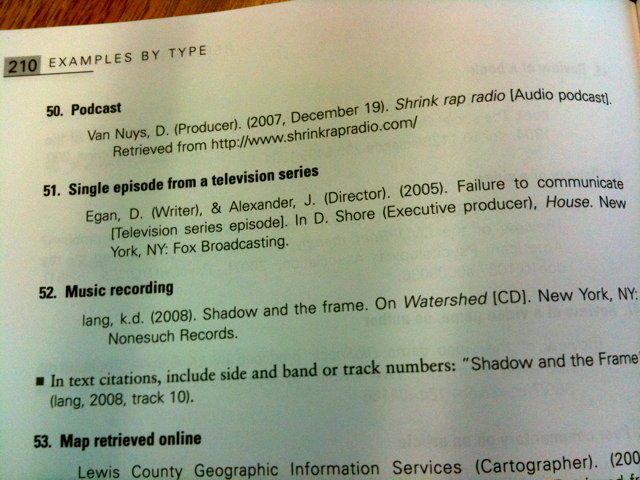
Shrink Rap Radio (2012). APA Style Manual [Image], Retrieved, April 9 2012,  from: URL http://www.shrinkrapradio.com/about/shrink-rap-radio-in-the-apa-style-manual/


I've had some more questions about the E-Portfolio which is due on the last day of class (the 13th of April).


  • NO you do not need to include a Delicious tag cloud. Delicious no longer supports this and your assignment does not ask you to do this. Please make sure you are looking at the current assignment (and not last term's one): found here.
  • Your final reflective blog post means I am looking for you to tell me about your learning throughout the term. You can disagree with using Facebook, LinkedIn, blogs, Twitter etc...BUT tell me why. Use examples to support your analyses. I am looking for you to show me your critical thinking; why you are thinking the way you do. Use examples, use resources, refer to class content and readings
  • In your final reflective blog post PLEASE remember to include the links to your FIVE comments that you have made throughout the term
  • YES even if you are including photos that you took (so there is no copyright issue) you MUST still include a caption/reference noting all the pertinent information following APA style

Again, if you have any questions, don't hesitate to e-mail me.

I'm including the assignment information below too:


ALES 204 E-Portfolio Term Project
Total Value: 35%

As we proceed through the term your writer’s toolbox will grow.  Blogging for this class will help you not only keep track of what you’ve been learning but it will also give you a space to stretch your communication muscles. Communicating well in various modes, text, image and sound are part of this class’s learning outcomes that you can practise in your own blog posts.
This term assignment is not really about specific instances of “science.”  Rather, this assignment is an opportunity to make broad observations of kinds of scientific knowledge and professional composition in relation to what we’re learning in the class.  You do not have to write a blog post for every single class that we have.  You must do at least five posts and two side-bar widgets.  In most instances I WILL assign you a blog post topic (such as the Introductory blog post and the final reflective post) – that will count as your E-Portfolio – but you will have the opportunity to choose ONE topic AND, if you wish to write any extra posts, those topics will be also be your choice (though they must be related to class content).  With this E-Portfolio you have a chance to participate in an online environment that is becoming increasingly important for the future; both in education and employment.  

At the end of the term, you will have written at least five blog posts.  In each blog post you must:
  1. Include at least one image
  2. Include at least one external link (somewhere out in the WWW)
  3. Include at least one reference to a fellow student’s blog post (you must link to the post, i.e. internal link)
  4. Be on topic (i.e. related to our class work).
  5. Each blog post should be at least two paragraphs but no more than four.

Additionally, throughout the term you must comment on at least five blog posts written by fellow students in this class. You can find links to the students’ blogs on the class blog, under the Module 2 blog post.

Comments, like all the writing and interaction in this class, must remain appropriate in level (writing style, mechanics and punctuation) and collegiality.  In your final blog post for this project you will need to include links to the five (or more) comments you made.

Mandatory Blog Post Topics
  • Module 2: Introductory Blog Post
  • Module 3: Embed the Flickr photo of your paper (or online) Facebook profile.
  • Module 10: Wikipedia stub entry (not required for CSL students)
  • Module 10: Optional Post (only for CSL students)

Additional E-Portfolio entries include (to be completed by the end of the term, 13th April.):
  • Embed your Twitter feed in the sidebar of your blog.
  • At least ONE blog post on a topic of your choice
  • Reflective blog post. Please add links to your FIVE comments here on your final reflective blog post.

Important Elements to Note:
1) All related links, images, audio and any other multimodal device must be appropriate, and you must CITE the reference information using APA style, even if the images are your own work.
2) The internet and computers can have hiccups. Save, save, save your work.  
3) Use your writer’s toolbox in your blogs – there’s no excuse for forgetting to capitalise, incorrect punctuation and txt spk (unless that is part of the assignment).
4) Remember to label your posts appropriately.
5) This is an individual project.  You are to write each blog post on your own. There is opportunity to collaborate by commenting on other blog posts.

Note on Computer Access:
You will have the chance to write blog posts on your own time and by using any of the computers available at the University of Alberta campus.  As a class we now have all lab sessions in computer labs during which there may be opportunity to craft a blog post.


Due Date: 13th April 2012, 17:00


Monday, April 2, 2012

Module 12: Labs

In labs this week you'll have the opportunity to practise the interviewing and podcasting information we're talking about all week. I know you just can't wait!

Some of the things you're going to be doing:
image from audio boo.fm


  1. Find a partner
  2. Together, read through this handout
  3. Choose whether you will ask employment questions, behavioural questions or journalistic questions
  4. Take a few minutes to create some questions for each other
  5. Conduct your interviews and record it using audioboo (your TA can help you)
  6. Remember, you have the choice to announce your real name in the interview or use an alias
  7. Think about your voice, breathing and pacing.
  8. Share the link to your audioboo recording with your TA.

Read more in the google doc here.


Wednesday, March 28, 2012

Science Article Assignment: Questions Answered

A number of students have come forward noting the differing information they have been receiving about the Science Article Assignment and how this new information does not correspond with the assignment I have given you. Let me clarify, PLEASE follow the assignment guidelines!


  1. Each option requires that you write your answer in a memo style. Even Option 4 if you are "translating" your academic paper into a more general paper - follow the memo style and include headings (for examples of headings see Option 1 which has a list) OR for Option 4 you might just be including a poster translation. Remember to SINGLE space your work BUT double space between headings.
  2. Have a look here for a great example of how a memo looks. NOTE this is just to give you an IDEA of how a memo looks. I am not asking you to follow all the ideas, but the basic structure is correct. You do NOT have to bold the first sentence (but you can if you prefer) AND see the last paragraph that talks about citation, it suggests to do what your professor asks...and that is to include an APA style reference list!
  3. Another question that has come up: students have asked whether they need to address all the prompter questions I have included in some of the Options. No, of course not. I have included lots to get you thinking. I am looking for a strong analysis of a few ideas (demonstrating your critical thinking) RATHER than a superficial summary of a lot of ideas.

Thursday, March 22, 2012

Wikipedia E-Portfolio Assignment

I have had a few questions from students so let me clarify this assignment a bit more.


The assignment to write on Wikipedia is really to show you how easy it is for anyone to create information there and hence, how unreliable it might be. Remember, in academia we're interested in peer-reviewed scholarly sources (usually!). It also helps you as students to become producers and communicators rather than simply consumers of information. This is something too that you can add to your CV to show how you engage with content (in your field).

BUT the way we will mark the assignment is really focused on the e-portfolio entry. If you look at the wikipedia assignment google doc you will see that the rubric is really geared to the analysis/critical interpretation of your ACT of writing the wikipedia article rather than the article itself. We're more about marking the reflective content rather than the entry. Of course part of the content mark (how focused etc it is) comes from the Wikipedia article you have written too.


This Wikipedia article forms part of the e-portfolio which means when you write your blog post ABOUT the writing of your article:
  1. Include at least one image
  2. Include at least one external link (somewhere out in the WWW – probably to your article)
  3. Include at least one reference to a fellow student’s blog post (you must link to the post, i.e. internal link)
  4. Be on topic (i.e. related to our class work).
  5. Each blog post should be at least two paragraphs but no more than four.


Note on Quality of E-Portfolio and Wikipedia Article Content:
Rating
Characteristics
4
Exceptional. The blog entry is focused and coherently integrates examples with explanations or analysis. The entry demonstrates awareness of its own limitations or implications, and it considers multiple perspectives when appropriate. The entry reflects in-depth engagement with the topic and demonstrates interaction and engagement with lecture content. Appropriate references are included to support arguments.
Submitted on time.

Wiki:
  • Length: For the purposes of this assignment, a reasonable article will contain 300-600 words, which correspond to 1.5-3 pages of standard double-space text.
Content: Neutral and verifiable
Uses quotations
Uses twitter alias or real name for revision history/marking purposes
3
Satisfactory. The blog entry is reasonably focused, and explanations or analysis are mostly based on examples or other evidence. Fewer connections are made between ideas, and though new insights are offered, they are not fully developed. The entry reflects moderate engagement with the topic and lecture content. Some references are included.

Wiki:
  • Length: follows the recommended standard
Content: Neutral and verifiable
Uses quotations or paraphrases where appropriate
Uses twitter alias or real name for revision history/marking purposes
2
Underdeveloped. The blog entry is mostly description or summary, without consideration of alternative perspectives, and few connections are made between ideas. The entry reflects passing engagement with the topic and lectures. Few references are included.

Wiki article most copies with a few paraphrases
little to no referencing/citations
length is insufficient
Not a recognisable name/twitter alias
1
Limited. The blog entry is unfocused, or simply rehashes previous comments, and displays no evidence of student engagement with the topic or lectures. Insufficient references to support content.

Wiki simply copies text from elsewhere, no references, incorrect length
0
No Credit. The blog entry is missing or consists of one or two disconnected sentences. No referencing.
Submitted after the deadline.


Wiki - does not follow any of the recommendations for content or length


Wednesday, March 21, 2012

Note: Class Assignments and Referencing

Just a reminder to all #ALES204 students:

In all your e-portfolio posts you are required to include an image - remember that the image MUST be cited appropriately using APA style

In all your other assignments (such as the Science Article Assignment) you will refer to academic peer-reviewed work which must be cited within your own essay/argument AND you will need to include a list of references. All of this must follow APA style.

Monday, March 5, 2012

Lecture 18: Writing and Reading Academic Articles

During today's lecture we will review how to read an academic article. It is quite different from reading something (a book, a magazine, tweets) for fun. Now we're reading for a distinct purpose.

The article I will ask you to read is this one:


Volume 19, Issue 16, November 2011, Pages 1876–1883
Promoting Transformation towards Sustainable Consumption and Production in a Resource and Energy Intensive Economy - the Case of Finland


The link is here:
 http://www.sciencedirect.com.login.ezproxy.library.ualberta.ca/science/article/pii/S0959652611001569

You will need your University of Alberta login to access this via the library (the above link). You can also read the article here: https://docs.google.com/open?id=0BzsIVysTrCWkYTA2UkZod1BSZk9tQk1EdkxtYlhGQQ


After five minutes of reading, you will be asked to stop reading and fill in this reading questionnaire:


You can read the Harvard Report here.


Another in class activity we will do uses information found here; Pivotal Words handout via the Dartmouth Academic Skills Centre.

Remember, during labs you will have further opportunity to review the Science Article Assignment. You will also let your TA (and I) know which option you will be choosing. You will do this by sending us an e-mail. You can review the assignment and rubric here.

Wednesday, February 29, 2012

E-Portfolio Term Project - Reminder

A few students have asked for the links to the e-portfolio and the e-portfolio rubric.


Here they are again:

The E-Portfolio Assignment: https://docs.google.com/document/d/1QuA2S2tuOMJT_KZVtGFwbpnT5xMHZAtjzb-LT2U7J3c/edit?authkey=CMX7040E

The E-Portfolio Assignment Rubric:
https://docs.google.com/document/d/1agxOkoNAUgpS8ZWVxe5VuoXbEEFpyMULe3K4oMG1pA0/edit

NOTE: There is NO post due at the end of the E-Portfolio week!!! See the syllabus for due dates for specific posts. This is an opportunity to work on the post of your choice AND/OR spruce up your blog template, colour scheme, twitter feed etc...

Wednesday, February 15, 2012

E-Portfolio Week

"Electronic Portfolios (e-Portfolios) are dynamic, developmental spaces representing your professional "self" on the Web. They are becoming standard practice for academics, students, and professionals and typically include examples of skills and achievements, as well as a reflective blog element. "


A reminder to all that the week AFTER Reading Week is our E-Portfolio week. This is your opportunity to add some of those important elements (think Twitter feed) and work on your reflective and own choice blog posts.

Here is the link to the e-portfolio rubric: https://docs.google.com/document/d/1agxOkoNAUgpS8ZWVxe5VuoXbEEFpyMULe3K4oMG1pA0/edit

And here is the e-portfolio assignment: https://docs.google.com/document/d/1QuA2S2tuOMJT_KZVtGFwbpnT5xMHZAtjzb-LT2U7J3c/edit?authkey=CMX7040E

A reminder that certain posts for the e-portfolio have different requirements such as the Facebook Page you already created and the upcoming Wikipedia Stubb Assignment. All posts for the e-portofolio HOWEVER must include what is listed on the assignment sheet (image, internal, external links etc...)

As always, please let me know if you have any questions.

Here is a little video about e-portfolios from Penn State University. Although the video is geared to Penn State students, the narrator does show some important elements that we are including in our own e-portfolios:


Sunday, January 29, 2012

Lecture 9: Death by PowerPoint and Hurrah for Pecha Kucha!

Before we get to the real meat (get it Aggie students?!) of today's lecture, I would like to remind you about your participation in this class. Participating, sending tweets, adding blog comments, discussing in class and in labs is all to help you learn and engage with the course content. Re-writing what someone has  already tweeted is not demonstrating your engagement with the ideas, you are simply quoting or paraphrasing or even summarising.

So, this is why I ask you to be critically literate and to critically think about your contributions.

Image from Harold Jarche.


Besides the tips and examples I will show in the lecture, have a read of these notes from Copy Blogger who succinctly summarises some key aspects of critical literacy:


Little Details MatterPay attention to words like ‘may’, ‘can’, and ‘will’. There’s a huge difference between something thatwill [insert marvelous benefit here] and something that might do the same. Never accept anything at face value.
Question the AuthoritiesIf a piece of content quotes an expert to help support the argument or conclusion, ask questions. What qualifies the individual to give advice? What credentials does the person have to make claims? Why is he or she an authority on the subject?
Sweeping Away StatementsOver-generalization usually discredits an argument’s validity from the get-go. Knock down sentences that use words like ‘all’ and ‘everyone’. Not all people do, and not everyone knows. More careful wording such as ‘most’ and ‘some’ pass muster more easily.
Scarecrows and Straw MenWatch out for fallacies. Fallacies are the tricky smoke and mirrors that divert attention from true critical thinking. There are a ton of fallacies, all built to deflect, detract, divert and discredit arguments without really doing so.
Let Down Your GuardOne of the biggest obstacles to creative thinking is bias, also the enemy of critical thinking. Your values, emotions, desires and experiences influence your beliefs and your ability to have an open mind. Set them aside and take the time to ponder information you receive wholeheartedly.
A last note: Be prepared to accept that someone’s arguments are true. Debating validity can be fun; it doesn’t always mean that you’re right.
You can also follow these suggestions:


Image from DocStock presentation found here.

Tuesday, January 24, 2012

Lecture 7: Facebook, Science & Business

For our homework activity:

•With a partner or in small groups, please respond to the following. Be sure to add your comment (and group members’ names) to the WALL of our ALES204 Facebook Page: http://www.facebook.com/pages/ALES-204-Dr-Laccetti/311657842204554?sk=wall
•RE: David Carr's article, "Why Twitter Will Endure” write a brief synopsis of the article.
•Note:
•something NEW that you learnt from the article
•something that you ALREADY knew.
Lecture 7: Facebook Page Assignment
View more presentations from Jessica Laccetti.


A reminder that the Facebook Page is part of your e-portfolio so please be sure to include all those elements as listed in the assignment which can be found here.

Monday, January 23, 2012

Module 3: Facebook for Business


Students, as a comment to this post, leave a link to your blog with your flickr photo of your professional Facebook PAGE (not a profile!).

DUE: 17:00 on Friday, 27th of Jan. 2012

In the words of a previous ALES204 student, this is what the assignment requires:


  1. "Create a page" on my existing Facebook profile that is like an e-Resume 
  2.  Take a 'print screen' picture of the page with the basic information wall showing
  3. Save this photo in Flickr and post it on my blog
  4. Write 2-4 paragraphs on my blog pertaining to my facebook page
  5. Post a link on the class blog that connects you to my blog post with the flickr photo


Remember, this assignment forms PART of the e-portfolio and as such, needs to follow those guidelines:


At the end of the term, you will have written at least five blog posts.  In each blog post (EXCEPT the first Introductory post) you must:
  1. Include at least one image (properly cited)
  2. Include at least one external link (somewhere out in the WWW)
  3. Include at least one reference to a fellow student’s blog post (you must link to the post, i.e. internal link)
  4. Be on topic (i.e. related to our class work).
  5. Each blog post should be at least two paragraphs but no more than four.


Additionally, here is a rubric for the profile itself:


Thursday, January 19, 2012

Module 2: Science Journalism & Online Class

The Social Media Survey that you need to fill in for Friday's Class:

NOTE: There have been some questions about the LinkedIn profile - IF you already have an account with LinkedIn, please feel free to add it. If you don't, please don't worry - we will cover this topic later in the term. This is just a survey to see how many students have already joined before ALES204.

Also, there is a question asking for the link to your blog, this is the link to your e-portfolio which you will have started by the end of Friday's online class.

Remember too, you are free to use an alias in any of your online participation/assignments JUST be sure you let us (the TAs and I) know AND fill in the Twitter Alias form here.


Don't forget to leave a link to your new ALES204 blog in the comments section, and remember to include your Lab Section in the comment. Feel free to tweet it too!

Wednesday, January 18, 2012

A Few Reminders

Image from Quality Solicitors.

Have a read of these reminders - they will help you be successful in ALES204:


  1. Please remember to complete the Twitter Alias form so that the TAs and I can track aspects of your online participation. The form can be found here. 
  2. The form can also be found and completed via the Lecture 3 Blog Post: http://ales204-2012.blogspot.com/2012/01/lecture-3-blogging-twitter-and-science.html
  3. Please note that ALL marks for your assignments will be available via e-class. They will not be distributed in class or in labs, so PLEASE remember to check in on e-class. 
  4. E-Class is where all your class e-mails will go. E-mails might be about an assignment change or lecture cancellation and these will all be sent via e-class.
  5. Although you may already use Twitter and Facebook (and other social media platforms) we are using them in an academic sense. That means we strive to remain professional, cordial and academic. There should be no inappropriate images, language or context in any of our work (online and offline) for this class.
  6. This ALES204 class is focussed on the digital generation and how these communication tools will help you to clearly communicate your research and your career objectives. The theory we talk about (and watch, read, discuss, and otherwise interact with) may, at first, seem different from the theory you studied in physics or bio or nutrition, but it is important to remember that this content is academic and is about sharing with you all the ways your future employer (and grad. schools!) will expect you to communicate.
  7. A main objective in this class is not just about how to use Twitter or manage a blog (as for your e-portfolio) but it's about using these tools to effectively communicate and engaging with what other people in our fields are researching and discussing.


As an aside, if you decide to use blogger (which I recommend) for your e-portfolio, I highly suggest you use a gmail (or other) address and NOT your U of Alberta account which does not have full functionality. For example, the U of Alberta e-mail does not allow easy uploading of images to one's blog (and this is necessary for the e-portfolio).


As always, please let me know if you have any questions: laccettiATualberta.ca


Lecture 5: Science Journalism Part II


Today's lecture:


Although we only watch a few minutes of the Future of Science Journalism video, you might want to watch more:


Here is a link to the E-Portfolio assignment. Be sure to follow all the guidelines!
Remember, Friday is an ONLINE class. You'll need to complete the following by 11:50am on Friday:


By the end of class students must:
nComplete the social media survey on the Module 2 blog post
nSet up a blog using Blogger (recommended) and write an introductory post about you and your field of study and what role communication plays in your work (dissemination of results, linking with fellow researchers, etc.…)
  • remember, you will want to choose a professional name for this ALES204 e-portfolio

nIn a comment on the Module 2 blog post, leave a link to your newly started blog (absolutely necessary so the professor and TAs can grade your work)
nNote: you require a personal blog for your E-Portfolio.
nNote: follow ALL e-portfolio guidelines (images, links and proper citations)